About Me
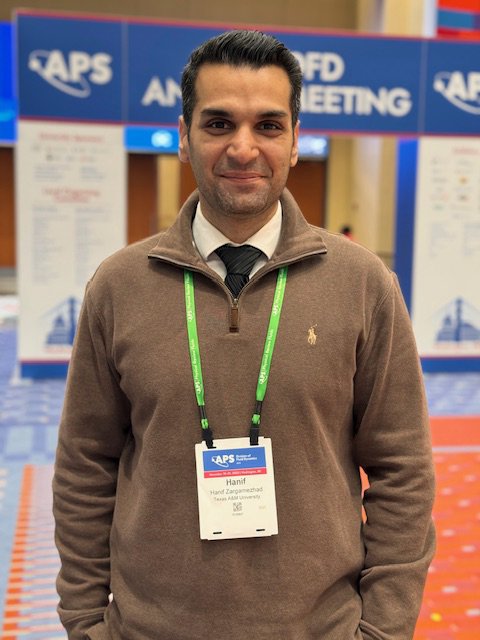
Education and Work Background
I am Hanif Zargarnezhad, Ph.D. in Mechanical Engineering from Texas A&M University, with a specialized background in Computational Fluid Dynamics (CFD), turbulence modeling, and multiphase flow physics. My work focuses on developing high-fidelity simulation tools to address complex fluid and particle dynamics relevant to both engineering applications and natural phenomena.
During my Ph.D., I developed advanced numerical models to study radiation-driven, particle-laden flows using the FLASH hydrodynamics code. This involved coupling Eulerian-Lagrangian methods to simulate multiphase instabilities such as the Rayleigh-Taylor instability, incorporating effects like radiative transfer, gravity, and condensation. My work contributed to both fundamental understanding and computational tool development for multiphase flows in extreme conditions.
In my Master's research, I focused on simulating two-phase, multi-component transport in the porous gas diffusion layer (GDL) of PEM fuel cells using the Lattice Boltzmann Method. By combining pore-scale imaging with multiphase flow simulations, I investigated the impact of microstructure and anisotropy on water management and transport efficiency in fuel cells.
Beyond my core research, I have led side projects such as simulating particle dynamics due to the effect of shear force (Saffman force) and particle sedimentation in confined geometries, providing insights into experimental challenges like early-time particle clustering. This experience has strengthened my ability to bridge experimental observations with numerical modeling to solve practical engineering problems.
I have extensive experience with open-source platforms such as OpenFOAM, DEAL.II, and FLASH, as well as strong programming skills in Fortran, C++, and Python. I enjoy building not only simulation tools but also automated post-processing and data visualization solutions for large, adaptive mesh datasets.
I am passionate about interdisciplinary collaboration, mentoring students, and contributing to research teams that tackle real-world challenges through simulation and computational science.
Sincerely,
Hanif Zargarnezhad
Doctoral Dissertation, Texas A&M University, 2025
Full text (OAKTrust repository)